 HarmoniaMentis
Seizures beget seizures

Summary
The impact of seizures goes beyond episodic manifestations of these repetitive events. Recurrent seizures trigger a cascade of cellular, network, structural, and systemic changes in the brain that contribute to cumulative disease burden and potentially progression. Therefore, seizure freedom with minimal or no adverse events (AEs) should be the key goal of epilepsy treatment.1
Main points
The concept that ‘seizures beget seizures’ was first proposed as early as 1885.2 As scientific knowledge has evolved since then, it has become clear that seizures trigger a cascade of cellular, network, and systemic alterations, resulting in chronic changes in the brain that ultimately lead to not only further seizures but also cognitive and psychiatric comorbidities that add significant burden to patients, caregivers and society.1
Multilevel impact of recurrent seizures in epilepsy1

Neuroinflammation
Blood-brain barrier dysfunction
Receptor/channel alterations
Hub connectivity changes
Aberrant sprouting
Cognitive association
Ventricular-brain ratio change (SE)
Injury
Psychiatric comorbidity
QoL
DALYs/economic burden
Recurrent seizures trigger cellular pathophysiological changes and network remodeling in the brain
Seizures result in:

Reactive oxygen species generation and accumulation, increasing metabolic strain on neurons and eventually leading to neuron death1

Neuroinflammation that contributes to hyperexcitability and reinforces epileptogenic networks1

Remodeling of neural circuits that increase the frequency and reduce the threshold for further seizures1
Seizures accelerate structural brain changes that impact cognition
Many people with epilepsy experience progressive cortical thinning beyond normal aging, suggesting progressive atrophy and neurodegeneration over time.1 This process is associated with cognitive decline and psychiatric comorbidities, such as depression.2
Seizure frequency and drug resistance have been associated with structural changes in the brain that resemble premature aging.3,4
Cellular, synaptic, and structural changes create a positive feedback loop that increases the likelihood of further seizures and contributes to the progression of epilepsy and its comorbidities.1
The self-reinforcing seizure cascade1
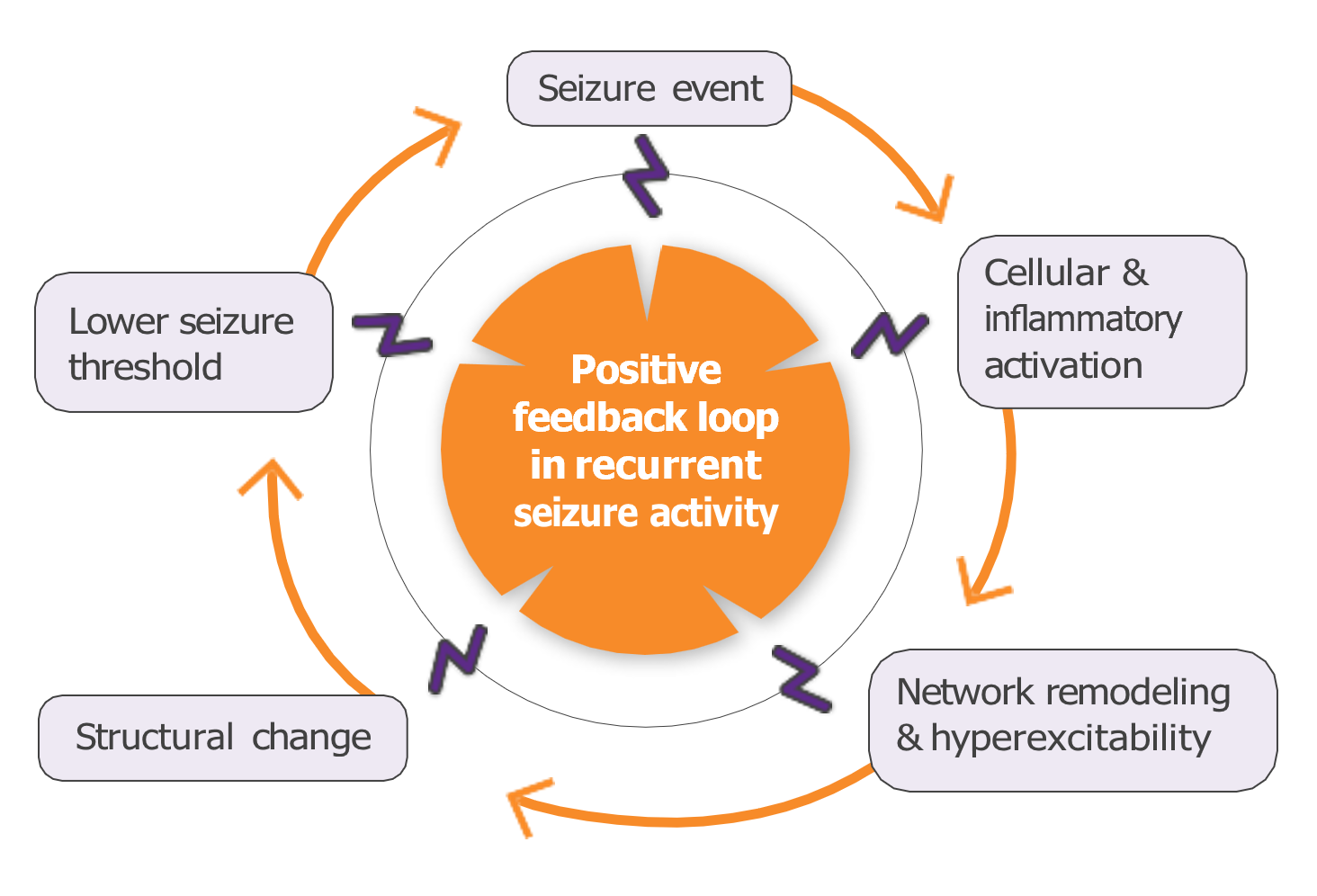
The positive feedback loop of persistent seizures translates to substantially increased clinical and societal burden
Epilepsy imposes a significant burden both on individuals, caregivers, healthcare systems, and society, particularly among those with uncontrolled epilepsy.1 The burden extends beyond seizures themselves and impacts every aspect of patients’ lives.
comorbidities
daily living
burden
“The numerous downstream processes triggered by recurrent seizures that contribute to disease progression, neurological impairment, and worsening comorbidities underscore the need for early and effective treatment to eliminate seizures.”1
CONCLUSIONS
- Seizures act as catalysts for cellular, network, and structural changes that increase seizure susceptibility and reinforce epileptogenic processes.1
- The burden of ongoing seizures on patients, healthcare systems and society is multifaceted and remains high.1
- Early and sustained seizure freedom remains central, not only for symptom control but to potentially limit cumulative neurological and systemic burden.1
Abbreviations
AE, adverse event; DALY, disability-adjusted life years; QoL, quality of life; ROS, reactive oxygen species; SE, status epilepticus; SUDEP, sudden unexpected death in epilepsy
- Walker MC, et Epilepsia Open. 2025;10(6):1762-1773.
- Ioannou P, et Brain Behav. 2022;12(9):e2589.
- Verma G, et al. Epilepsy Behav Rep. 2022;18:100530.
- Pardoe HR, et Epilepsy Res. 2017;133:28-32.
- Lhatoo SD, Sander Epilepsia. 2005;46(Suppl 11):36-39.
- Whitney R, Donner Curr Treat Options Neurol. 2019;21(2):7.
- Harden C, et Neurology. 2017;88:1674–1680.
- Mühlenfeld N, et Chin J Traumatol. 2022;25(5):272-276.
MAT-UKI-0422-P | August 2026