 HarmoniaMentis
C021 post hoc analysis: responder rates and seizure frequency

The efficacy of adjunctive ONTOZRY® (cenobamate) in clinical trials
The efficacy of adjunctive ONTOZRY® for the treatment of uncontrolled focal onset epilepsy was evaluated in two multicentre, randomised, double-blind, placebo-controlled efficacy and safety studies and in one open-label safety study.1–3
ONTOZRY® (cenobamate) C021 safety study
C021, was a Phase III, open-label, multicentre, long-term, safety and pharmacokinetic study of ONTOZRY® as adjunctive therapy in patients with partial onset seizures.3
ONTOZRY® (cenobamate) C021 post hoc analysis: responder rates and seizure frequency
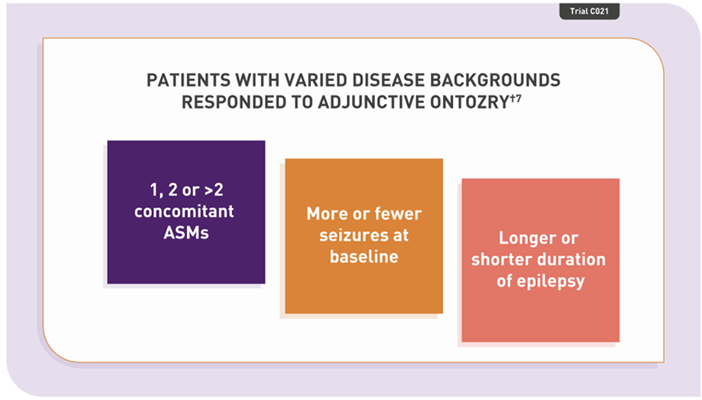
Aside from the findings of the study that are related to the safety profile of ONTOZRY®, the study data also demonstrated that patients with varied disease backgrounds responded to adjunctive ONTOZRY®.8
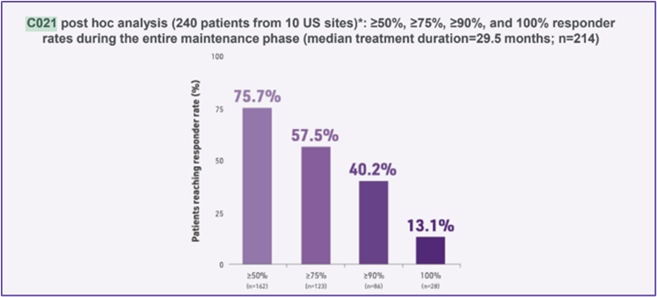
Post hoc analysis (240 patients from 10 US sites): ≥50%, ≥75%, ≥90%, and 100% responder rates during the entire treatment period, during the titration phase, and during the maintenance phase (median maintenance treatment duration=29.5 months; n=214).9
Responder rates observed in a C021 post hoc analysis support the efficacy observed with adjunctive ONTOZRY® in the C017 trial.9
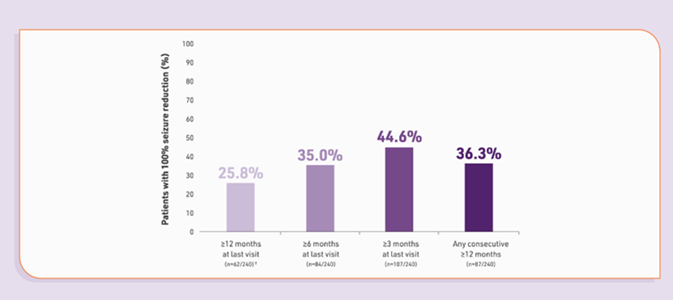
In a post hoc analysis of 240 patients in the safety study C021, 36.3% (n=87) were seizure-free at any consecutive ≥12-month duration of the study.9
Post hoc analysis showed that the mean duration of 100% seizure reduction was 23.5 months and the median duration of exposure for the 240 patients in the post hoc open-label study was 30.2 months.9
C021 post hoc analysis (240 patients from 10 US sites)*: ≥50%, ≥75%, ≥90%, and 100% responder rates during the entire maintenance phase by focal seizure subtypes (median maintenance treatment duration=29.5 months; n=214).9
Responder rates with adjunctive ONTOZRY® were consistent in most patients with different focal seizure subtypes.9
Abbreviations
ASM, anti-seizure medication; EMA, european medicines agency; FDA, food and drug administration; ILAE, international league against epilepsy; OLE, open-label extension; SoC, standard of care.
- Krauss GL, Klein P, Brandt C, et al. Safety and efficacy of adjunctive cenobamate (YKP3089) in patients with uncontrolled focal seizures: a multicentre, double-blind, randomised, placebo-controlled, dose-response trial. The Lancet Neurology. 2020;19(1):38-48. doi:https://doi.org/10.1016/s1474-4422(19)30399-0
- Chung SS, French JA, Kowalski J, et al. Randomized phase 2 study of adjunctive cenobamate in patients with uncontrolled focal seizures. Neurology. 2020;94(22):e2311-e2322. doi:https://doi.org/10.1212/wnl.0000000000009530
- Sperling MR, Klein P, Aboumatar S, et al. Cenobamate (YKP3089) as adjunctive treatment for uncontrolled focal seizures in a large, phase 3, multicenter, open‐label safety study. Epilepsia. 2020;61(6):1099-1108. doi:https://doi.org/10.1111/epi.16525
- Klein P, Aboumatar S, Brandt C, et al. Long-term Efficacy and Safety From an Open-Label Extension of Adjunctive Cenobamate in Patients With Uncontrolled Focal Seizures. Neurology. 2022;99(10):e989-e998. doi:https://doi.org/10.1212/WNL.0000000000200792
- Sander JW, Rosenfeld WE, Halford JJ, Steinhoff BJ, Biton V, Toledo M. Long‐term individual retention with cenobamate in adults with focal seizures: Pooled data from the clinical development program. Epilepsia. 2021;63(1):139-149. doi:https://doi.org/10.1111/epi.17134
- Rosenfeld WE, Abou‐Khalil B, Aboumatar S, et al. Post hoc analysis of a phase 3, multicenter, open‐label study of cenobamate for treatment of uncontrolled focal seizures: Effects of dose adjustments of concomitant antiseizure medications. Epilepsia. 2021;62(12):3016-3028. doi:https://doi.org/10.1111/epi.17092
- Sperling MR, Abou‐Khalil B, Aboumatar S, et al. Efficacy of cenobamate for uncontrolled focal seizures: Post hoc analysis of a Phase 3, multicenter, open‐label study. Epilepsia. 2021;62(12):3005-3015. doi:https://doi.org/10.1111/epi.17091
MAT-UKI-0451-P | June 2026