 HarmoniaMentis
Investigating ONTOZRY®▼(cenobamate) in the early adjunctive setting

Investigating ONTOZRY® in the early adjunctive setting
Randomised trials and real-world studies have demonstrated the utility of adjunctive ONTOZRY® in patients with focal-onset seizures who have failed numerous prior ASMs.2-5 Seizure response with ONTOZRY® was assessed by number of prior ASMs in a large Polish real-world cohort across 20 centres.1





• 2–3: 8.6% (n=41)
• 4–7: 52.4% (n=249)
• >7: 38.9% (n=185)

Indication for United Kingdom: ONTOZRY® is indicated for the adjunctive treatment of focal-onsetseizures with or without secondary generalisation in adult patients with epilepsy who have notbeen adequately controlled despite treatment with at least 2 anti-epileptic medicinal products 7
Indication for Republic of Ireland: ONTOZRY® is indicated for the adjunctive treatment of focal-onset seizures with or without secondary generalisation in adult patients with epilepsy who have not been adequately controlled despite a history of treatment with at least 2 anti-epileptic medicinal products 7
Higher seizure freedom rate with early use
Seizure freedom and ≥50% and ≥75% response rates were higher with ONTOZRY® in patients receiving 2–3 prior ASMs compared with those who had received >3 prior ASMS. 1
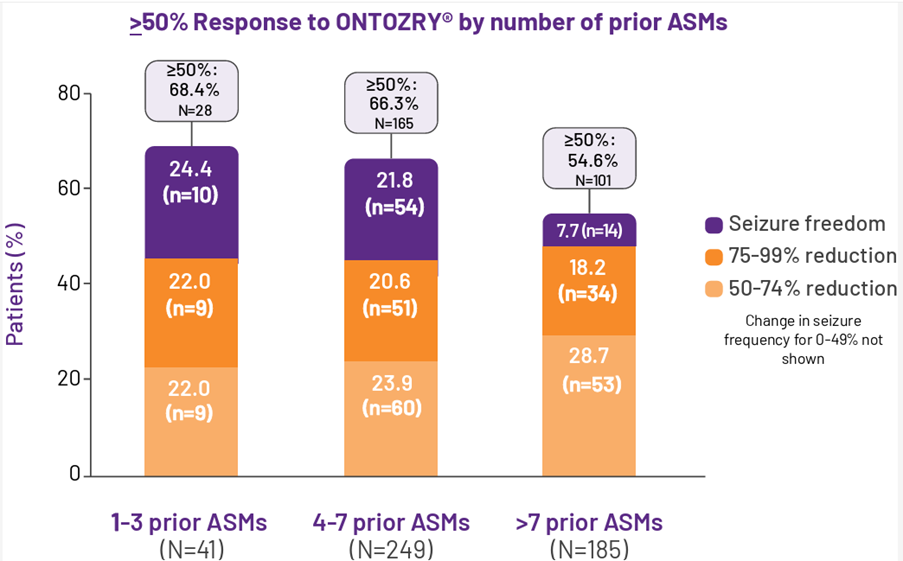
Median monthly seizures significantly decreased from 6 at baseline to 2 (0-250) at follow-up with add-on ONTOZRY® in patients who had received 2–7 prior ASMs, versus 5.3 (0-150) in those with ≥7 prior ASMs (p<0.0001).1
The baseline frequency of seizures in patients receiving in the past 1–2 and 3–7 ASMs was comparable, median 6 (range, 0.16–300) and 6 per month (range, 0.38–450), respectively P = 0.6675; and higher in the group treated with >7 ASMs (median 12; range, 1–270; P < 0.0001). At the end of observation, the median monthly seizure frequency decreased to 2 (range, 0–250), 2 (range, 0–300), and 5.3 (0–150), respectively; P < 0.0001).1
ONTOZRY® is generally well tolerated in clinical practice*
In this large real-world cohort, AEs were consistent with the known profile of ONTOZRY®:1

The most commonly reported AEs were somnolence (25.5%, n=121) and dizziness (9.1%, n=43)

Of patients reporting AEs, 75.6% (n=164) resolved during the study period

No concomitant ASM classes were more associated with an increased AE profile
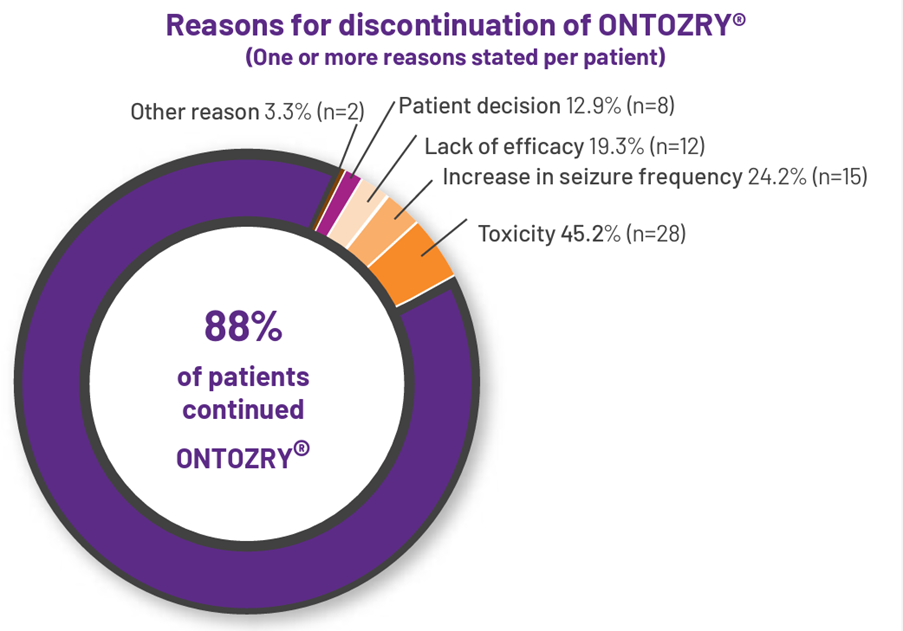
Only 12% (n=62) of patients discontinued ONTOZRY® for one or more reasons during follow-up. 1
ONTOZRY® enabled substantial treatment simplification. 69.7% of patients (n=331) reduced or discontinued ≥1 concomitant ASM (43.6% (n=207) discontinued; 40.2% (N=191) dose reduced). Dose reductions primarily included sodium channel blockers such as LCS and LTG. 1
CONCLUSIONS

ONTOZRY® demonstrated real-world effectiveness, with greater seizure freedom and ≥50% and ≥75% response rates when introduced after 2–3 prior ASMs. 1

These findings are in line with a previous multicentre real-world study indicating that early add-on treatment with ONTOZRY® after 2–3 prior ASMs is more effective than its use following numerous ASM trials.6

The results demonstrate the potential of adjunctive ONTOZRY® to reduce the burden of epilepsy in individuals in their productive years, when seizures are likely to significantly impact physical and psychological health. 1
Find out more about epilepsy and the role of add-on ONTOZRY® in clinical practice.
*For the full list of adverse events please consult the ONTOZRY® Summary of Product Characteristics
Abbreviations
AEs, adverse events; ASMs, antiseizure medications; LCS, lacosamide; LEV, levetiracetam; LTG, lamotrigine
- Bosak M, et al. Seizure. 2025;130:25-31. Erratum in: Seizure 2025;132:196.
- Krauss GL, et al. Lancet Neurol. 2020;19(1):38-48.
- Klein P, et al. Neurology. 2022;99:e989-e998.
- Roberti R, et al. Epilepsia. 2024;65:2909-2922.
- Villanueva V, et al. Epilepsia Open. 2023;8:918-929.
- Lattanzi S, et al. Epilepsia. 2025;66:2239-2252.
- ONTOZRY® Summary of Product Characteristics. United Kingdom and European Union.
MAT-UKI-0421-P, August 2026