 HarmoniaMentis
ONTOZRY®▼(cenobamate) 5-year, real-world evidence confirms a high proportion of seizure-free days

-
KEY TAKE AWAY
5-year, real-world evidence (RWE) from the C017 study’s open-label extension (OLE) confirms Ontozry’s effectiveness, with a high proportion of seizure-free days, sustained epilepsy burden reduction, durable retention and acceptable tolerability1
Main points
Reducing seizure burden, by reducing not only the frequency but also the number of days with seizures, can markedly impact and improve multiple domains of health-related QoL in a significant manner, such us:

The proportion of seizure-free days increased significantly from 64.4% (n=354) at baseline to 88.6% (n=206) by Year 5 in the mITT population (median duration of cenobamate exposure was 5.4 years, (range 0.1 – 5.6))1
-
The modified intent-to-treat (mITT) population from the OLE study was used for analysis and included all study participants who had received at least one dose of cenobamate and had any post-baseline seizure data
Percentage of seizure-free days in the mITT population during the OLE by year1
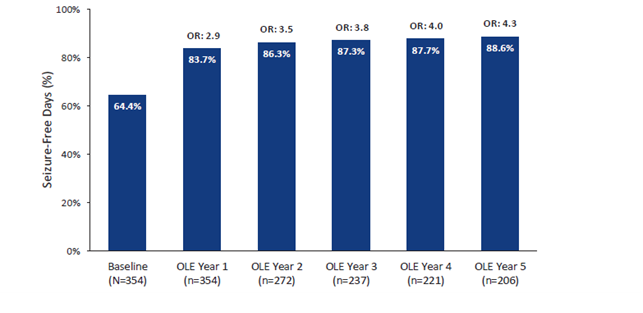
Adapted from Serratosa JM, et al. Epilepsy Behav. 2026;179:1109601
- Participants achieving ≥90% to <100% seizure reduction were seizure-free for 97.9% days during the entire OLE (n=59/60). This group saw their percentage of days with seizures decline from 33.2% at baseline to only 1.2% at Year 51
- A significant reduction in seizure burden was observed across all seizure types. For focal to bilateral tonic-clonic seizures (FBTCS), which are associated with a higher risk of SUDEP, they occurred on <1.0% of days in 100% responders (n=108) during the OLE, highlighting its critical impact1
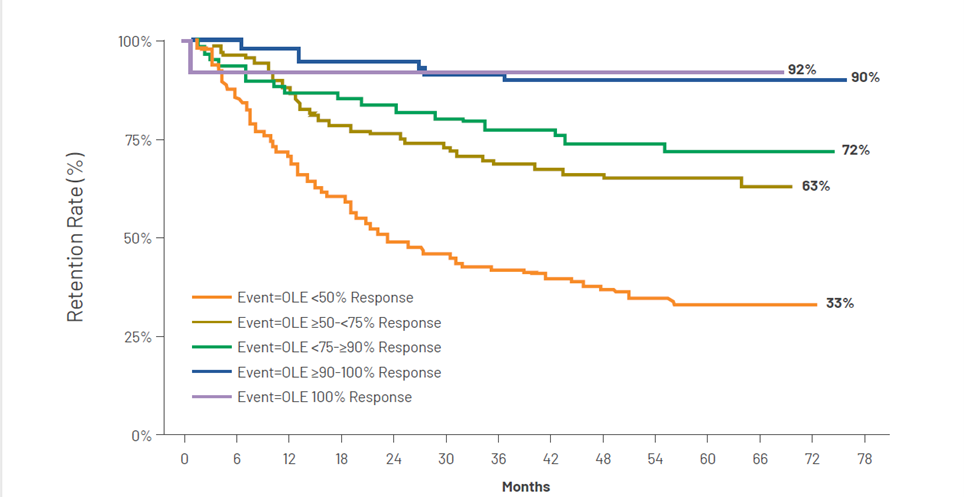
Time to Discontinuation and Retention Rates by Responder Status
| Number at risk | |||||||||||||
|---|---|---|---|---|---|---|---|---|---|---|---|---|---|
| 128 | 111 | 90 | 74 | 60 | 57 | 52 | 49 | 46 | 43 | 41 | 13 | 1 | 0 |
| 91 | 88 | 80 | 71 | 69 | 66 | 61 | 60 | 59 | 58 | 58 | 18 | 0 | 0 |
| 62 | 58 | 54 | 53 | 51 | 49 | 47 | 47 | 45 | 45 | 44 | 19 | 2 | 0 |
| 60 | 60 | 59 | 57 | 57 | 55 | 55 | 53 | 53 | 53 | 53 | 18 | 4 | 0 |
| 13 | 12 | 12 | 12 | 12 | 12 | 12 | 12 | 12 | 12 | 12 | 5 | 0 | 0 |
Adapted from Serratosa JM, et al. Epilepsy Behav. 2026;179:1109601
CONCLUSIONS
- These findings suggest that even without achieving 100% seizure freedom, clinically meaningful improvement in seizure burden can be obtained1
- These results further support the long-term efficacy of adjunctive cenobamate in adults with focal onset seizures1
- These results suggest that a high reduction of seizure burden can be achieved and maintained by many people with epilepsy taking adjunctive cenobamate, potentially leading to an improved QoL1
Abbreviations
FBTCS, focal to bilateral tonic-clonic seizures; mITT, modified intent-to-treat; OLE, open-label extension; OR, odds ratio; QoL, quality of life; RWE, real-world evidence; SUDEP, sudden unexpected death in epilepsy.
- Serratosa JM, et al. Seizure-free days as a clinical outcome measure of reduced epilepsy burden: 5-year outcomes with cenobamate treatment. Epilepsy Behav. 2026;179:110960.
MAT-UKI-0496-P | September 2026