 HarmoniaMentis
Potential of ONTOZRY®▼(cenobamate) as an early adjunctive treatment for refractory focal seizures

* There are no RCT data for treatment comparisons. The Gold standard in treatment comparison is head-to-head randomised clinical trials. Caution should be used when interpreting these data.
SUMMARY
In a real-world cohort of patients who had failed 2-3 prior ASMs, ONTOZRY®▼ (cenobamate) achieved significantly higher 12-month retention rates, seizure freedom and response rates, as well as significantly greater quality-of-life improvements, compared with lacosamide (LCS), levetiracetam (LEV), valproate▼ (VPA), and topiramate▼ (TPM).1,2,*
No significant differences in overall adverse events were observed between ONTOZRY® and the comparator ASMs.1 The higher 12-month retention rate of ONTOZRY® underscores the overall clinical value of ONTOZRY®, reflecting sustained efficacy, tolerability, and patient quality of life in routine practice.1,2,*
Potential of ONTOZRY® as an early adjunctive treatment for refractory focal seizures
Several real-world studies have previously evaluated the clinical value of adjunctive ONTOZRY® in treated patients with refractory focal seizures, reporting retention rates of 80 and 87% (n=41/51, n=40/46 respectively) among patients with a median of 10–12 prior ASMs.3,4 Given the reported benefits of ONTOZRY® in this challenging patient population, a key clinical question was whether patients earlier in the treatment journey could also achieve similar responses, particularly in comparison with other ASMs.
High retention rates with adjunctive ONTOZRY®
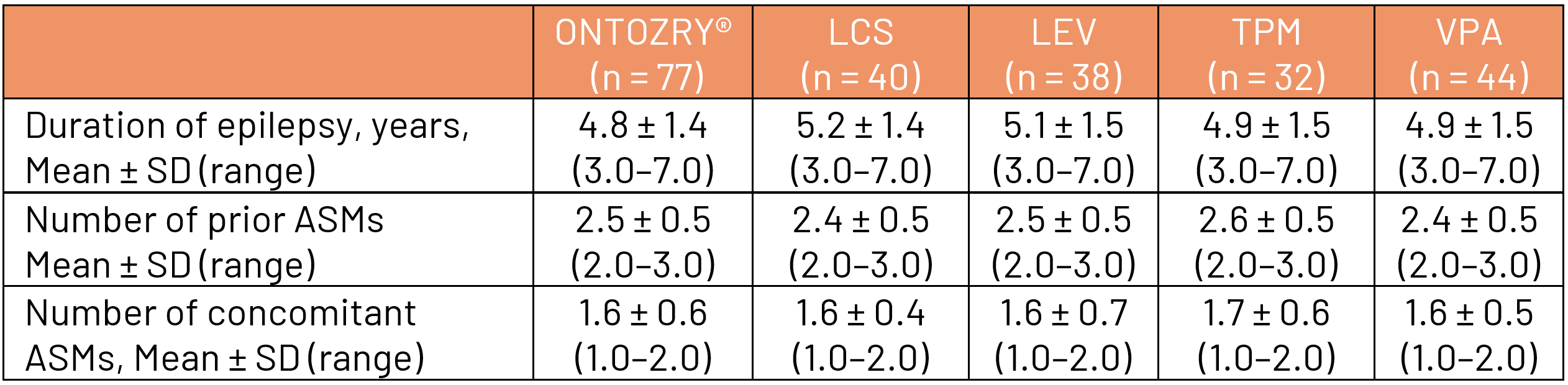
Early adjunctive use of ONTOZRY® compared with other ASMs was assessed in a cohort of 231 patients with focal-onset seizures who had failed 2–3 prior ASMs from the Mainz Epilepsy Registry.1
Baseline Clinical Characteristics1
After 12 months, adjunctive ONTOZRY® had a significantly higher retention rate compared with other ASMs.1
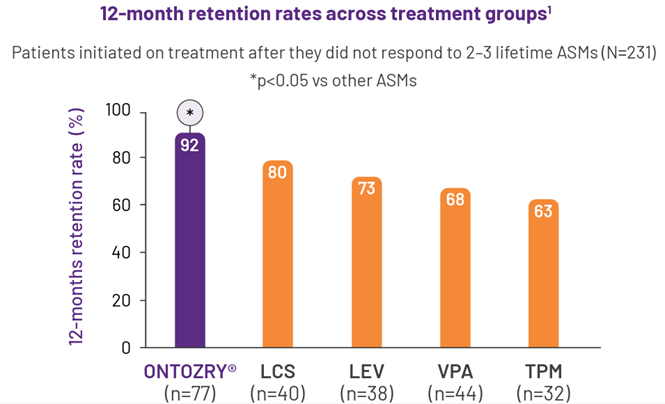
Retention rates are an established marker of the effectiveness, tolerability profile of a treatment in clinical practice.1 In early therapy lines ONTOZRY® had the highest retention rate compared with lacosamide, levetiracetam, valproate, and topiramate.1
High seizure freedom rate with adjunctive ONTOZRY®
Similarly, in the Mainz cohort, significantly more patients receiving ONTOZRY® achieved seizure freedom, ≥75% seizure response and ≥50% seizure response at 12-month follow-up compared with other ASMs.1
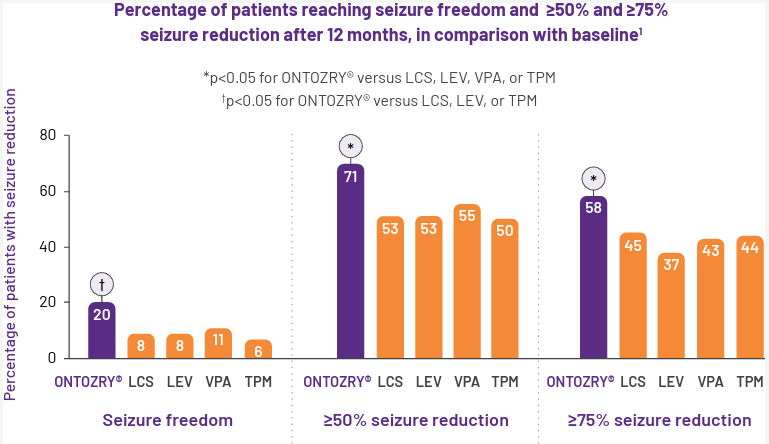
Seizure freedom, ≥50% and ≥75% seizure response rates were all higher with ONTOZRY® than with the other ASMs included regardless of the seizure subtype, including focal to bilateral tonic-clonic, focal impaired awareness (now classified as focal impaired consciousness5), focal aware motor, and focal aware non-motor seizures.1
Improvement in quality of life with adjunctive ONTOZRY®
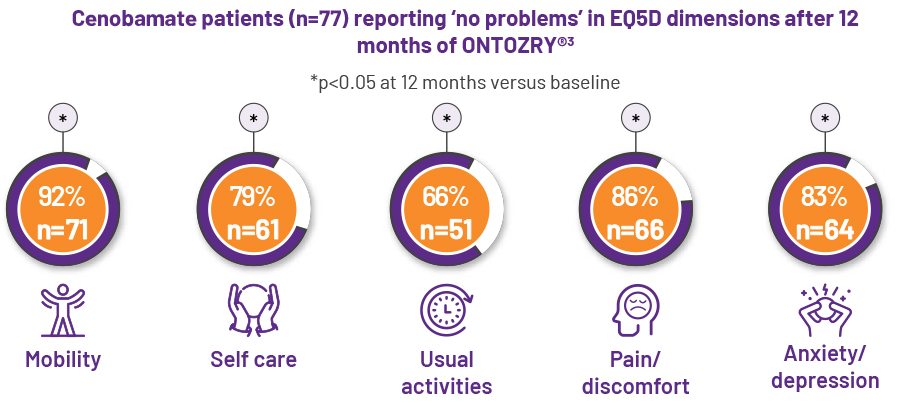
The effectiveness of ONTOZRY® after 2–3 prior ASMs observed in the Mainz cohort translated to significantly greater improvements in patients’ quality of life compared with other ASMs at 12-month follow-up.2 The quality-of-life findings were consistent across three commonly used and validated scales, EQ5D, EQVAS and QOLIE 10.2
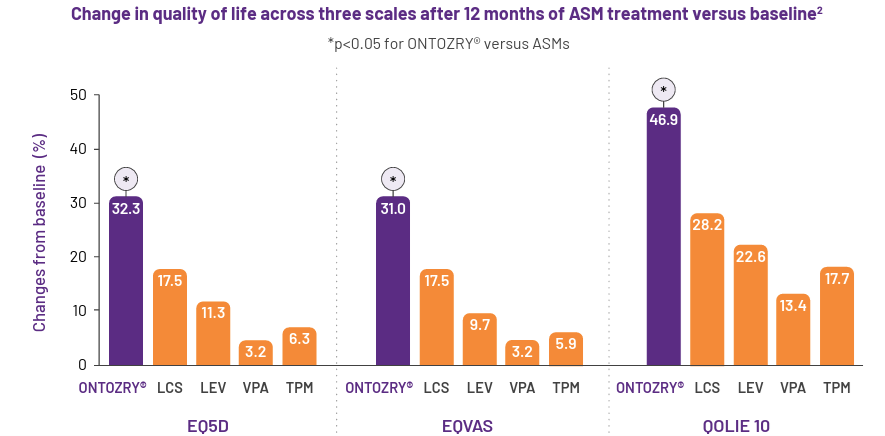
Patients receiving ONTOZRY® experienced significant improvements in all dimensions of the EQ5D index at 12 months follow-up versus baseline (p<0.05).2
Comparable tolerability profile between ASMs
In the Mainz cohort, adverse event profiles were similar between ONTOZRY® and other ASMs.1 The most commonly reported adverse events with ONTOZRY and the other ASMs, were somnolence, dizziness, and fatigue.1 No serious side effects were reported.1
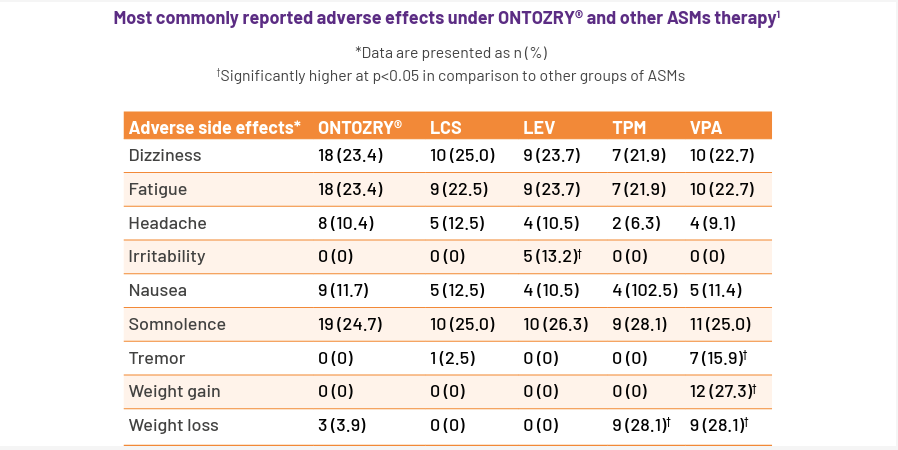
For the full list of adverse events, please consult the ONTOZRY® Summary of Product Characteristics
Early adjunctive treatment with CNB helped to reduce the drug load by up to 53% in combination with CLB. The most marked dose reduction was observed with CLB followed by: 23.4% with ESL, 23.0% with LCS, 19.3% with LTG, 12.3% with VPA, 7.6% with BRV and 2.9% with LEV - p < 0.05 for comparisons: CNB vs. VPA, LTG, LCS or ESL.2
Implications for clinical practice
It has been reported that patients face greatly diminished chances of seizure freedom with each failed line of ASM treatment.6 This context underlines the importance of using ONTOZRY® as an early adjunctive therapy to maximise the chances of seizure freedom and optimise patient outcomes.1,2
Learn more about the real-world benefits of ONTOZRY® as an early add-on treatment of focal seizures.
Abbreviations
ASMs, antiseizure medications; BRV, brivaracetam; CLB, clobazam; EQ5D, EuroQol-5 Dimension; EQVAS, EuroQol Visual Analogue Scale; ESL, eslicarbazepine, LAM, lamotrigine; LCS, lacosamide; LEV, levetiracetam; QOLIE-10, Quality of Life in Epilepsy-10; TPM, topiramate; VPA, valproate
- Winter Y, et al. CNS Drugs. 2024;38:733-742.
- Winter Y, et al. Epilepsy Behav. 2025;10;175:110835.
- Beltrán-Corbellini Á, et al. 2023;111:71-77.
- Villanueva V, et al. Epilepsia Open. 2023;8(3):918-929.
- Beniczky S, et al. Epilepsia. 2025;66:1804-1823.
- Chen Z, et al. JAMA Neurol. 2018;75(3):279-286.
MAT-UKI-0423-P | October 2026